Showing posts with label HealthyPerformer. Show all posts

Monday, 25 April 2016

Triple - The Healthy Performer - Blog 8 - 25/04/16

It has now been 2 weeks since my training programme began and I feel I have made an intriguing amount of progress. Below is the change in my measurements from the start to after week one (all measurements are in inches):

Biceps: 14 to 15
Forearms: 12 to 13
Chest: 38.5 to 39.5
Abs: 35.5 to 35
Quads: 24 to 25
Calves: 17 to 18

To speed up my progress, I have raised the amount of reps for each set exercise and raised the time I ran for.

Below is my new workout programme for week 3:

Monday, 18 April 2016

Triple - The Healthy Performer - Blog 7 - 18/04/16

It has now been a week since my training programme began and I feel I have made an intriguing amount of progress. Below is the change in my measurements from the start to after week one (all measurements are in inches):

Biceps: 13.5 to 14
Forearms: 11.5 to 12
Chest: 38 to 38.5
Abs: 36 to 35.5
Quads: 23 to 24
Calves: 16.5 to 17

To speed up my progress, I have raised the amount of reps for each set exercise and raised the time I ran for.

Below is my new workout programme for week 2:


Monday, 21 March 2016

Triple - The Healthy Performer - Blog 6 - 21/03/16

Today we performed two different circuit training exercises.

We began the lesson by learning what circuit training is and why it is done:

Circuit training is a form of body conditioning or resistance training using high-intensity aerobics. It targets strength building and muscular endurance. An exercise "circuit" is one completion of all prescribed exercises in the program. Circuit training can be targeted at a specific area of the body (e.g. core, legs, upper body) or it can be broad and have each exercise work on a different part of the body.


We began with our first circuit! This circuit consisted of a lot of leg work and was very stamina based. From previous experience in padwork (Two year of martial arts and boxing training), I was prepared for how tiring it would be. The skipping was very vigorous as if we were to stop at any time to rest there would be a 30 push-up penalty. Below is the circuit we did:


The second circuit was much more intensive on our abs than the rest of our body as it featured sit-ups, leg raises and ab twists. Below is the circuit we did:

Thursday, 17 March 2016

Triple - The Healthy Performer - Blog 5 - 17/03/16

Today, we watched an educational video on the skeletal and muscular systems in the body. We did this in order to gain a better understanding of how our bodies work which helps us target which areas of our bodies we want to improve.

Below is a collaboration of the research I've made including outside of class:

Respiratory System
  • The respiratory system is the set of organs that allows a person to breathe and exchange oxygen and carbon dioxide throughout the body.
  • Before blood can find its way into the bloodstream, oxygen has to get into the lungs; plus, the carbon dioxide has to find its way out. You accomplish these tasks by breathing air in and out via the respiratory system. 
  • This system is divided into two parts: the upper respiratory tract and the lower respiratory tract.
Parts of the upper respiratory tract:
  • Nose/Mouth: The nose draws in air through the nostrils and into the nasal cavity. The mouth also draws in air, especially during times of physical exertion or when the nose is “stuffy.”
  • Laryngopharynx: Air passes through the nasopharynx and oropharynx toward the laryngopharynx, which is the opening to the larynx (or voice box).
Parts of the lower respiratory tract:
  • Trachea: The trachea (or windpipe) continues from the larynx.
  • Bronchi: The trachea splits into two bronchi that each lead to a lung.
  • Lungs: Each lung is divided into lobes. The right lung has three lobes and the left lung has two.
  • Alveoli: The bronchi branch into smaller bronchioles that lead to the alveoli, which are small air sacs surrounded by capillaries (very small blood vessels). Gas exchange between the air and blood occurs across the alveolar and capillary walls.
As air is breathed in through the lungs, it travels down the Trachea through the Larynx, into the lungs. It travels through the Bronchi into the Alveoli. The O2 molecules diffuses through the cell membrane of the capillaries seamlessly, which allows the oxygen to enter the bloodstream. The remaining elements inside the lungs is breathed out. Carbon dioxide is also released from the body where we break down glucose and oxygen into water and carbon dioxide. Water is released through sweat, while carbon dioxide diffuses through the cell membrane of the capillaries.

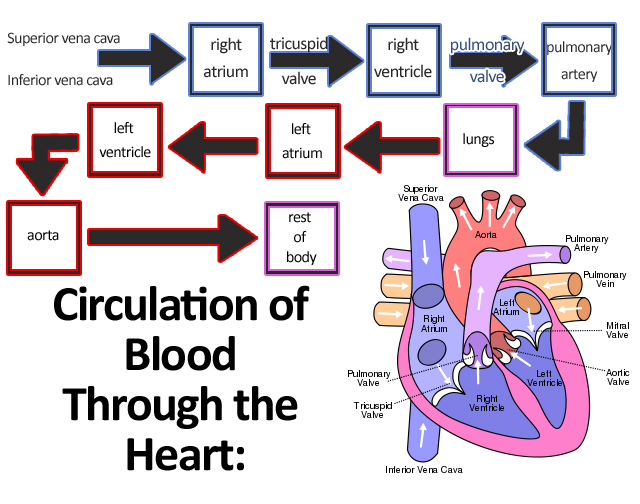
Circulatory System
  • The job of the circulatory system is to transport food and oxygen to the cells of the body and collect waste products of the body.
  • The heart is the size of an adult's fist and beats, on average, 100,000 times per day. This would mean the heart pumps approximately 5 gallons of blood a day.
  • If we joined all of our blood vessels together end to end it would reach a distance of over 60,000 miles; over two times the circumference of the earth.
  • There are three types of blood vessels:
    • Arteries: Carries de-oxygenated blood to the lungs.
    • Veins: Carries oxygenated blood to the heart and then to the rest of the body.
    • Capillaries: Allow water, oxygen, carbon dioxide, and other nutrient and waste substances to exchange between blood and surrounding tissues.
  • Beats of the heart are regulated by the pacemaker which is located at the top of the right atrium.
  • The cardiac muscle is exclusive to the heart and never gets fatigued. The heart is protected by the ribcage.
  • Mitral valves make sure the blood flows through the heart only one way.
  • Heart is separated (by the septum) into two sides to not allow the oxygenated blood and de-oxygenated blood to mix.
The process of blood circulation
  • De-oxygenated blood returns to the heart after flowing through the body.
  • The blood enters the right side of the heart through the right atrium, through the tricuspid valves, through the right ventricle and pumped out to the lungs by the pulmonary arteries.
  • The lungs refresh the blood with a supply of oxygen which turns the blood red.
  • The oxygenated blood enters the left side of the heart through the left atrium, through the mitral valves, through the left ventricle and pumped out to the rest of the body by the aorta.
  • Systole is when the heart is contracted and is when the blood from the ventricles are pumped out of the heart. The right ventricle contracts a bit sooner than the left ventricle.
  • Diastole is when the heart is relaxed and the blood from the atria are pumped to the ventricles.

Sunday, 13 March 2016

Triple - The Healthy Performer - Research - 13/03/16

Last lesson, I set my target for the end of our 3 week training program: I want to improve my upper body strength and balance in order to perform lifts better. In order to achieve this, I will need to work on my abdominals, pectorals, biceps/triceps, lats and quads. In order to gain muscle in these areas, I need to be aware of which exercises will help me do so. Below is a list of exercises I found online which will aid me in my program:
  • Abdominals - plank, sit-ups/crunches, knee/leg raise, flutter kick, squat, woodchop, Russian twist, mountain climber.
  • Pectorals - bench press, chest press, dumbbell press, chest dip, cable fly.
  • Biceps/triceps - tricep dips, rope tricep pulldowns, overhead dumbbell extensions, bicep curls, reverse cable curls
  • Lats - barbell pullover, chin up, lat pulldown, pulley row
  • Quads - squat, lunge, step up, bear crawl sled drag, backward drag, bench jump
With this newly acquired knowledge on how to tone and build these muscles. I can now effectively train and make a difference to my body. 

Thursday, 10 March 2016

Triple - The Healthy Performer - Blog 4 - 10/03/16

Today we performed a flexibility workout which was led by Lorna. She had us doing lots of stretches which will make our muscles a great deal more flexible. Improving our flexibility decreases our risk of injury, helps our joints move through their full range of motion and improves blood flow through muscles, therefore improving our workout experience.

We were asked to come up with a goal for us to achieve so that we can monitor our progress throughout our program. My goal for this unit is to increase my upper body strength so that I am abler when performing lifts. In order to achieve this goal, I need to increase the size of my biceps, triceps, abdominals, lats, quads and pectorals. The type of exercises which will need to practise to achieve this are squats, deadlift, sit-ups, press-ups, bench press and bicep/tricep curls. Achieving this goal will give me a more masculine physique which, as an actor, will allow me to have a better chance at getting a masculine role in an audition.

Wednesday, 9 March 2016

Triple - The Healthy Performer - Blog 3 - 09/03/16

Today we focused on a healthy balanced diet including what to avoid eating when losing weight, what nutrients to avoid and which nutrients are helpful for a healthy lifestyle.

We first discussed how long a performer will be awake for and how long their days are, especially during show weeks. We all knew that the main nutrient they'd need for energy is carbohydrates. However, slow release carbohydrates, commonly found in brown rice, brown pasta (basically anything wholemeal), are much better for performers as they release the energy over a longer period of time compared to regular carbohydrates. We also found that grazing is very useful in a performers life. Grazing is the process of eating smaller meals but at more frequent intervals. As opposed to eating a big breakfast, lunch and dinner, performers would typically make these three meals smaller and add in snacks in between. This spreads out the release of carbohydrates and other nutrients in the body.

We also discussed different nutrients which you shouldn't eat too much of or any at all:

  • Saturated Fats - our bodies struggle to break down this type of fat so it's best not to consume this at all. Alternatives to Sat Fats are Mono-unsaturated and Poly-unsaturated Fats. These can be found in Walnuts, Avocados and Salmon.
  • Salt - maintains the correct balance of certain fluids which bathe the cells in our bodies. Research shows that too much salt can lead to increased blood pressure, osteoporosis - a bone-thinning disease, asthma, stomach cancer and weight gain. Foods high in salt include Bacon, Cheese and Pickles. Healthier alternatives include Tofu, Soya and Pulses.
  • Calories - a measure of the amount of energy in foods. On average, men need 2500 calories per day whilst woman only need 2000 calories per day and children only need 1800 per day! This is because men have more muscle mass which means they burn 20% more calories than women just by doing nothing.
We discussed how we can take into account these issues yet still make a tasty meal. We even discussed a meal that was designed on the spot for us on how beneficial for our health it is:

Wholemeal Pasta, Tuna, Tomato Sauce (Tomatoes, Basil, Pepper, Salt), Veg

Next lesson, we will have a flexibility work out session ran by Lorna.

Monday, 7 March 2016

Triple - The Healthy Performer - Blog 2 - 07/03/16

Today, we watched an educational video on the skeletal and muscular systems in the body. We did this in order to gain a better understanding of how our bodies work which helps us target which areas of our bodies we want to improve.

Below is the research I collated from the video:

Skeletal System
  • skeleton is a support structure and the framework of the body.
  • Humans have endoskeletons (skeletons in their body), while crustaceans have exoskeletons (skeletons outside their body)
  • Skull protects the brain, pelvis cradles internal organs, ribs protect lungs and stomach
  • Bones are a reservoir of minerals
  • There are 206 bones in the body and there are four types - long, short, flat, irregular (those who don't fit the other categories e.g. pelvis)
  • Skull, ribs and spine are the parts of the Axial Skeleton
  • Pelvis, arms, hands, legs, feet and shoulders are part of the Appendicular Skeleton
  • Types of joints include:
    • Fiberous - fibres join the bones
    • Cartlilaginous - cartilage joins bones
    • Bony - bones merge with age
    • Syvonial - lubed up joints
  • Pivot, ball and socket joints can move in all directions (Shoulders)
  • Hinge joints can only move in one direction (Elbow)
  • Saddle joint can only move in two directions (thumbs)
  • Types of bone:
    • Osteocytes - communicate changes in the bone
    • Osteoblasts - produces hard callus
    • Osteoclasts - removes any excess bone and callus
    • Osteogenic - differentiate and develop into other bone cells (the stem cells of bones)
  • Hematoma - blood leaked in bones when broke
  • Joints are held together by muscles, tendons and ligaments
  • Tendons connect muscle to bone and ligaments connect bone to bone
Muscular System
  • Muscles generate heat and support balance (Abs and back support balance)
  • Voluntary muscles are muscles you can control for everyday functions such as walking and moving arms
  • Involuntary muscles are muscles you can't control such as the beating of your heart and digestion
  • There are five types of muscle:
    • Fusiform - spindle, starts thin at the ends and gets thicker towards the centre (e.g. biceps)
    • Parallel - equally wide through the entire muscle (e.g. thigh)
    • Convergent - fan shaped (e.g. pectorials)
    • Pennate - feather shaped
      • Uni - all attached from 1 side (e.g. palmar interosseous)
      • Bi - all attached from 2 sides (e.g. rectus femoris)
      • Multi - all attached from multiple sides (e.g. deltoids)
    • Circular - around openings (e.g. mouth, eyes)
  • Larynx supports speech
  • Muscles work together not individually
  • Agonist and Antagonist - example: Biceps curl – the biceps is the agonist muscle causing the movement and the triceps are the antagonist muscle working in opposition to the biceps.
  • Flexors and extendors support head movement.
We were asked to conduct some additional research into different nutrients, vitamins and minerals and how they contribute to making our body healthier. This will help us target different areas of our fitness.

Carbohydrates: Carbohydrates are the main energy source for the brain. Without carbohydrates, the body could not function properly. Sources include fruits, breads and grains, starchy vegetables and sugars.

Fats: Fat is an energy source that when consumed, increases the absorption of fat-soluble vitamins including vitamins A, D, E and K. Twenty to 35 percent of your daily intake should come from fat. Sources include omega-3-rich foods like fish, walnuts and vegetable-based oils.

Protein: Protein is the major structural component of cells and is responsible for the building and repair of body tissues. Protein is broken down into amino acids, which are building blocks of protein. Sources include meat, beans and egg.

Vitamins:
  • Vitamin C - important in immune system (e.g. oranges/strawberries)
  • Vitamin A - important for healthy skin (e.g. broccoli/carrots)
  • Vitamin B1 - important for energy metabolism (e.g. whole grains/kidney)
  • Vitamin B2 - important for vision (e.g. poultry/fish)
  • Vitamin B6 - important for cell growth (e.g. liver/nuts)
  • Vitamin B12 - important for red blood cells (e.g. yoghurt/clams)
Minerals:
  • Sulphur - found in protein molecules (e.g. meats/egg)
  • Magnesium - important for making protein (e.g. nuts/seeds)
  • Phosphorus - important for healthy bones (e.g. meat/fish)
  • Chloride - needed for stomach acid (e.g. table salt/soy sauce)
  • Sodium - important for fluid balance (e.g. bread/milk)
  • Potassium - needed for muscle contraction (e.g. whole grains/legumes)
  • Calcium - important for healthy bones (e.g. milk/canned fish)
  • Iron - needed for red blood cells (e.g. red meats/shellfish)
  • Zinc - needed for making protein (e.g. whole grains/vegetables)
  • Manganese - part of many enzymes (e.g. widespread in foods)

Wednesday, 2 March 2016

Triple - The Healthy Performer - Blog 1 - 03/03/16

Today we began our new unit: The Healthy Performer!

We spent the whole lesson in the gym and we looked at the different gym equipment. We learnt how to use each piece and which areas of our body it focused on. Knowing this will ensure we pick the correct exercises/equipment to do/use when training specific areas of our body. For example, if wanted to work on my quads, I would perform squats, but if I wanted to work on my biceps, I would use dumbbells to perform bicep curls

We were asked to create a preliminary table for our workout routine. This is only a first draft, but below is my table: